
I am Paul. I kept the books for a freight company for twenty years, picked up a pencil at 44 the fall my daughter left for college, and had no art background to speak of. If you are reading this, you probably draw in the evenings after work, or on weekend mornings before the house wakes up, and you already know the feeling I am about to describe.
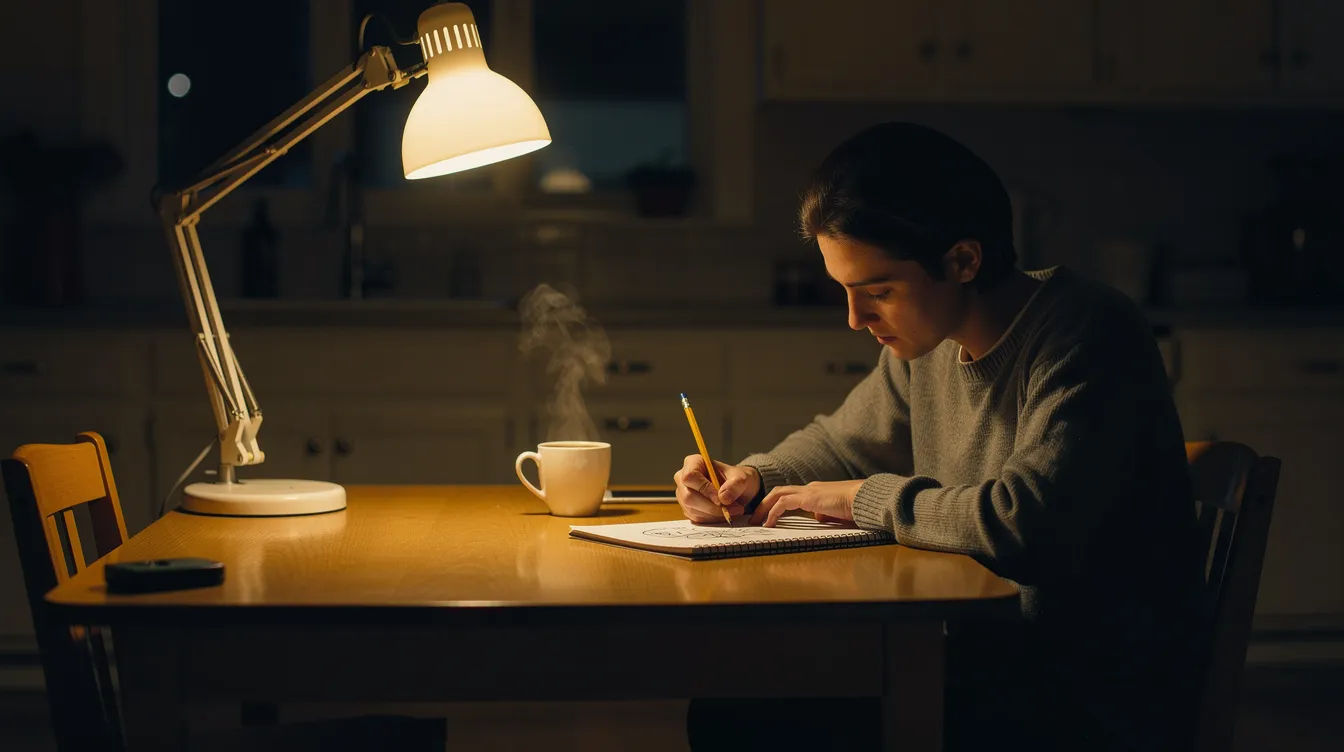
It is 10:37 pm on a Tuesday. You squeezed in 40 minutes to sketch at the kitchen table. The drawing is rough but you learned something. Then you open social media and instantly feel bad. Other artists are posting polished portraits, incredible landscapes, work that looks effortless. Your sketch suddenly feels like a grocery list.
Comparison is a common challenge for artists, and this article is about how to stop comparing your art so you can enjoy making your own. The main idea is simple: comparison is unavoidable, but we control how often we trigger it and what we do with it when it shows up. I still struggle with this, especially when so many artists post daily while I juggle a day job. Early on I spent as much time looking at other people’s drawings as making my own, and it took me an embarrassing number of weeks to realize that the scrolling was the problem, not the drawing.
Why we compare our art in the first place
Humans have always compared skills in a group. When there is no ruler or yardstick for “good shading,” we look sideways to see where we stand. Psychologists have a name for this habit. Social comparison, first described by Leon Festinger in 1954, is the built-in drive to evaluate ourselves by measuring against others. In 2026, social media amplifies it for artists by putting thousands of polished pieces in your pocket, available every idle moment. Most of these comparisons are fast and unconscious. You scroll, you see, you feel something, and you keep scrolling without ever naming what just happened.
Looking at other artists does help in some ways. It builds taste, shows what is possible, and gives you ideas for goals. We carry reference points in our heads that keep asking “where do I stand?” and sometimes the answer is useful. Comparison can motivate improvement, but it may also cause dissatisfaction, and knowing the difference matters.
Adults starting later carry an extra comparison: “where should I be by this age?” I felt it hard when I started at 44. I could tell a good drawing from a bad one. I just could not make a good one yet. Your eye runs ahead of your hand. You can recognize beauty in a drawing long before you can create it, and that gap feels like failure. It is not. It is what drives improvement. Artistic ability is not a competition. It is personal growth. And if you are quietly wondering whether it is too late to learn to draw, the research says no. Adults improve measurably in drawing accuracy and visuospatial skills even when they start with zero background. I wrote a longer piece on whether it’s too late to learn to draw for anyone who wants the full story.
How comparison quietly poisons your drawing time
Art is a long journey of learning and practice, but comparison can make it feel like a verdict handed down every evening. You see a stunning digital painting and your pencil sketch looks pointless. That is the “I’ll never be that good” syndrome, and it has real symptoms: closing your sketchbook early, abandoning a drawing halfway through, or avoiding starting at all. I used to close mine without ever opening it on bad nights.
Social media is a highlight reel. Finished pieces, good lighting, picked from dozens of tries, with the 30 ugly drafts hidden. I once asked a woman whose portraits I admired how long one of them took. About thirty hours, she said, and she started over twice. Social media shows only the highlights of others’ work, and we measure our rough drafts against their final cuts. Comparison can lead to feelings of inadequacy that have nothing to do with your actual progress.
Putting yourself against full-time professionals when you have 30 to 60 minutes a day is a mental game you cannot win. The emotional fallout shows up in real behaviors: deleting posts, hoarding drawings instead of sharing, jumping from style to style out of insecurity. None of that is about talent. It is about an unfair measuring stick.
Spotting unhealthy comparison in the moment
The first step in stopping negative comparisons is noticing them. Here are telltale signals you can catch mid-scroll or mid-drawing:
-
Thoughts like “I should be better by now,” “my art is childish,” or “there’s no point in putting this out into the world.”
-
Physical cues: tight chest, clenched jaw, the urge to throw away today’s sketch.
-
Behaviors: closing your sketchbook, switching to a tutorial video instead of practicing, or opening a new tab to look at better artists.
I had my own spiral a couple of years ago. I found an artist with hyper-detailed ink work and 40,000 followers. I spent twenty minutes going through their feed, and by the end I felt like my own artwork was a joke. That moment taught me something. Asking reflective questions, like “what am I actually feeling right now?” can help clarify feelings of insecurity in art.
My pause routine is three steps: notice the feeling, say “this is comparison,” then put the phone down on the table. The bookkeeper in me treats it like flagging an entry. Name it before you act on it. Catching it early is half the battle, especially for habitual social media checking.
Use social media on purpose, not on autopilot
Instagram, TikTok, YouTube, and art Discord servers are built to keep you scrolling highlight reels, not to protect your self-esteem. Limiting social media exposure can reduce feelings of inadequacy, but you do not have to quit entirely. You just need boundaries.
-
Schedule “inspiration windows.” Fifteen minutes on Saturday morning works better than grazing through feeds every night after work. If you notice you constantly feel bad afterward, take a 7-day break.
-
Curate your feed. Mute accounts that make you feel small. That is managing what goes into your head, not being petty. Follow artists at a similar level, and follow a few who openly show messy process and failures.
-
Try “one-in, one-out”: for every 10 minutes looking at other artists, spend at least 10 on your own work. My rule is to look only after I have drawn, never before, because then I have already done something that day.
Focus on your vision to avoid distractions from comparison. When you open social media with a purpose, like studying how someone handles light on fabric, you get something useful. When you open it out of boredom, you usually leave feeling worse.
Turn comparison into a structured learning session
Comparison becomes useful when it is intentional and time-limited, like a mini self-assigned lesson. Healthy comparison can inspire learning and improvement. Artists can treat comparison as a learning opportunity rather than self-criticism. Here is how:
-
Pick one artwork you admire.
-
Set a 15-minute timer.
-
Write down 3 to 5 specific things you like: lighting, edges, color choices, line weight, perspective.
-
Choose one element and try it in a small study.
Asking “what are they doing with their edges?” taught me more than any amount of envy ever did. The question shifts your thinking from “why am I not this good?” to “what can I steal as a technique?” A growth mindset helps break the cycle of unhealthy comparison because it turns the sting into a lesson plan.
Keep a “comparison notebook” or digital note where you log these observations and follow-up practice ideas. Over time it becomes a record of your own journey, full of interesting techniques you have absorbed in your own way.
Anchor your progress to your own journey, not other artists
Your own journey is the only fair measuring stick. Comparing your current sketch to last year’s sketchbook is far healthier than measuring yourself against a stranger’s highlight reel. Only compare yourself to your past work for improvement.
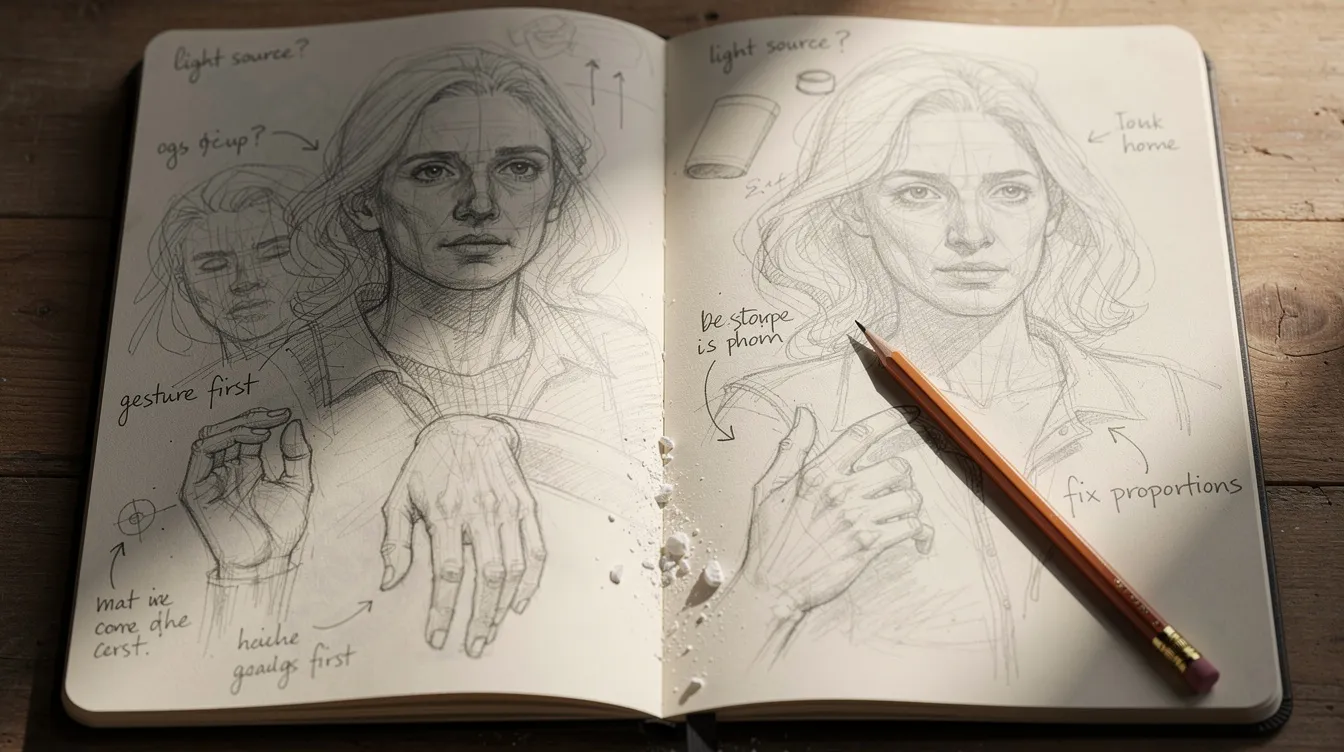
Here is what I do: I date every page, keep everything (even the ones I hate), and flip back every couple of months. Each January I photograph a drawing from one to three years ago and recreate the same subject. The same apple. The same mug. Side by side. I was genuinely surprised when my early shading looked like a child’s scribbles next to the newer version. I had learned more than I thought.
Dated pages are evidence on the bad days. “I couldn’t draw a convincing cup in March, and now I can.” The bookkeeper in me trusts a record over a feeling. Compare yourself to where you were a month ago, not to where a semi pro artist is after a decade of practice.
Adults learning art around 2020 to 2026 went through lockdowns, career shifts, and family responsibilities. Progress is never a straight line. If slow progress is wearing you down, I wrote about staying motivated when progress is slow. Write a short “art timeline” noting breaks for kids, jobs, illness, or study. Those are context, not failure. Appreciate your own journey and unique circumstances. Artists should measure progress against their past work instead of others.
Maintaining something like a “Joy Archive,” a folder of your favorite pieces, can help remind you of your progress when doubt creeps in. Your own sketchbooks hold clues to your emerging style that you will miss if your eyes are always on other artists.
Build respect for your own work and strengths
Try this: list 5 things you genuinely like in your current art, even minor ones. “My color choices are bold.” “I draw expressive faces.” “My lines have energy.” Recognizing personal artistic strengths fosters confidence in a way that no amount of scrolling ever will.
Those “imperfections,” wobbly lines, exaggerated proportions, limited palettes, often become style markers. Your flaws could point to a unique art style you are developing. I used to dislike my scratchy hatching. It looked rough and unfinished. Over time it became part of my recognizable look, and now people in my sketching group tell me they like it. Anyone can develop their own artistic identity through self-exploration, and it usually happens by accident while you are busy trying to fix what you think is wrong.
Try a weekly ritual: on Sunday night, pick one drawing from the week, write two sentences about what went well, and one note for gentle self improvement. Swap “am I good?” for “did I learn something tonight?” The first question carries a mood. The second has an answer. Celebrating small artistic accomplishments is essential for building confidence. No one is you, and that is your power.
Speak to yourself the way you would talk to a friend who just started drawing in their late thirties. You would not call their work garbage. You would point out what they got right.
Practical habits that reduce comparison by default
These are concrete strategies for people with full-time jobs and limited time:
-
Start with a 5-minute warm-up with the phone in another room. Creating art without pressure encourages experimentation, and removing the phone removes the temptation to scroll.
-
Keep one “offline sketchbook” that never gets posted. Purely for experiments, mistakes, and fun. Focusing on the process rather than the final product increases enjoyment of art.
-
Set a small, measurable monthly goal: “30 gesture drawings by November 30, 2026.” This appeals to the bookkeeper in me. You tick off your own boxes instead of watching others tick off theirs.
-
Find a tiny group of peers at a similar level. I joined a local sketching group: a retired nurse, a long-haul trucker, a dentist, two grandmothers, most of whom started after 40. Seeing real, imperfect work made at the next table is the antidote to the highlight reel. If there is no group near you, try a library bulletin board, a community center, or an art supply store.
Consistency beats intensity. Three 20-minute sessions a week in 2026 will put you far ahead of where you were in 2024. That is roughly 50 hours a year, which research suggests is enough to see noticeable improvement in your skills. If you want a structure to practice with, see my roundup of online drawing courses for adults.

Reframing jealousy into celebration and possibility
A sting of jealousy toward other artists is totally normal. Most artists feel it. The point is what you do with that feeling. Celebrate others’ successes instead of comparing yourself, and you will notice your mood shifts.
Ask yourself: “What does this artist’s success prove is possible for me in the future?” Successful people are not magic. They just kept going. When you admire someone’s craft, leave one genuine, specific compliment. Something like “I love how you handled the reflected light on the metal.” It nudges your brain from envy toward appreciation and connects you to the community instead of the competition.
There is space in the world for many voices, including yours. No one has your exact mix of life experience, job history, culture, and taste. No one can make your exact art. Mine includes twenty years of freight ledgers, a late start, and an imagination shaped by everything I saw from the cab of a delivery truck. That is not a disadvantage. It is a perspective.
When comparison flares up anyway: a simple reset routine
Even with every habit in place, comparison will happen. Art is a journey of learning, practice, and trial and error. Here is a 4-step reset for the moment it flares up:
-
Step away from the screen.
-
Name what you are feeling. Say it out loud if you need to.
-
Write one sentence about what you admire in the other artist’s piece.
-
Spend 10 minutes drawing something tiny for yourself.
Quick prompts for these moments: a 5-minute self-portrait, your coffee mug, your hand, or a shoe by the door. These are beginner drawing exercises that work at any level because they reconnect you to the process of making something. Imagine how many incredible drawings started as a quick sketch of whatever was on the table.
Decide one small boundary today. “No Instagram after 9 pm.” Or “no checking comments until I have drawn for 15 minutes.” One rule is enough.
Here is the image I want to leave you with: you, at your table, on your own journey, making something that did not exist yesterday, whether or not anyone online ever “likes” it. Your sketchbook is a private laboratory, not a scoreboard. Treat it that way and you will be proud of what you find inside it. I hope you pick up your pencil tonight. I will be at my kitchen table doing the same thing.
FAQ
Is it normal to feel discouraged by other people’s art? Yes. Nearly everyone who draws feels it, including people who draw well and people who went to art school. It is deeply human. The feeling fades as you build a record of your own progress and spend less time scrolling through what everyone else is doing.
Should I stay off social media while I learn? You do not have to quit. Limit it, follow artists who show process, look only after you have drawn, and mute any account that makes you feel bad. That alone can inspire you instead of deflating you.
How do I know if I am actually improving? Date your pages and compare across months, not days. Progress in drawing is slow and uneven, which can feel discouraging day to day. Redraw the same subject after a few months. The difference will be obvious and sometimes amazing.
Is a sketching group worth joining as a beginner? I think so. Groups give honest feedback and a realistic picture of what normal, awesome, in-progress work looks like. Most welcome total beginners, and you will achieve more when you see that every person at the table is figuring it out in their own way, just like you.