

No, it is not. Not at 30, not at 50, not at 70. Here is why I know, and here is how to start drawing.
Start Here: Is It Too Late To Learn To Draw?
I am Paul Brennan. I kept the books for a freight company in Kansas City for twenty years. I picked up a pencil for the first time at 44, the fall my daughter left for college. I had spent decades sure I was not the artistic type, and that fall I decided to find out whether I could draw at all. No art school background, no innate talent to speak of. I started The Hobby Artist because I wanted a place for adults with jobs, families and limited time who feel they missed their chance to learn to draw.
Drawing is a trainable visual skill. It is closer to learning to read music or picking up a new language than it is to some fixed childhood gift. The brain keeps forming new neural pathways at any age, and a motor skill is exactly what those pathways support. Anyone can learn to draw at any age, and it is not limited by age the way sports are. What a late starter has lost is not the ability but the years of casual doodling some people piled up as kids, when they would draw on anything within reach. A few months of steady, focused practice makes up for most of that gap.
I will point you to people who started at 45, 60 and 70 and were able to draw confidently within a year or two. But I want to be honest first: it was not easy for me. The fear that the door closed around age twelve turned out to be the least true thing I believed about drawing. If you can draw one rough sketch today, the rest of this post shows how to keep going.
Why We Believe It’s “Too Late” (And Why That’s Wrong)
The emails I get at The Hobby Artist follow a pattern. “I am too old.” “I have no talent.” “I should have started sooner.” Behind most of them is a story from school: a teacher who said you “can’t draw,” or being the sibling who was not “the artistic one.” That one comment filed drawing under talent instead of skill, and the belief stuck for decades. No matter what that teacher said, it was an opinion about one afternoon, not a ruling on your brain.
Then there is the comparison trap. You scroll through social media and see young artists posting polished work, and a voice says, “I wish I could draw like that.” What you do not see is the thousands of hours behind each post. Children begin scribbling around ages 1 to 2 to develop fine motor skills, and kids who draw well at ten usually drew a lot at six, seven and eight. That is the whole secret, not some magic gene.
Adult responsibilities make picking up a new skill feel harder because our time and energy are stretched, not because our brains cannot learn. I can tell you from experience: adults hate being bad at something, especially when we are good at other things. After twenty years of competent bookkeeping, a first month of lopsided apples was uncomfortable. But the science is clear. Research on neuroplasticity confirms the brain keeps building new connections after childhood. Studies with adults aged 65 to 87 showed significant improvement in drawing from observation after structured practice. If they can learn to draw at 75, you can learn at 45.
Drawing In “Old Age”: What Really Changes And What Doesn’t
“Old age” is different for everyone. Many Hobby Artist readers start to draw in their 50s, 60s and 70s. After about 60, some things change: eyesight may lose contrast sensitivity, hands may be less steady, and energy for long sessions drops. Fine detail work and marathon drawing days get harder.
But fine motor control and visual judgment still improve with practice at any age. Drawing later in life enhances fine motor control and improves visual-spatial reasoning. And there are strengths that grow with age: patience, focus, tolerance for repetition, and a clearer sense of what is actually fun to draw. I can point to the people in my local sketching group who are a bit older and producing some of the most interesting work.
Many older artists drift toward looser, sketchier styles that favor expression over microscopic realism. That is a valid artistic choice, not a downgrade. As long as you can hold a pencil and see the page, you can learn to draw, even if you adapt with thicker pens, better lighting or a magnifier.
Inspiring Late-Starters: Real People Who Began Drawing Later In Life
When I doubt my own progress, I look at people who started well after 40 and kept going.
Grandma Moses took up the brush in her late seventies and went on to paint over 1,500 works. Her folk art now hangs in major museums, and she became one of the best known American artists of the twentieth century. The “too late” line has been crossed by people with far less time ahead of them than you. Vincent Van Gogh started to draw seriously at age 27 and would paint for only about a decade before his death in 1890, yet his art changed the world. Van Gogh’s early sketches were clumsy, and he kept at them anyway, which is how people learn. Many artists began a new career in their 30s and 40s and went on to do remarkable things.
Closer to home, my local sketching group is full of inspiration. Most of them started after 40, including a retired nurse, a long-haul trucker, a dentist and two grandmothers. None of them went to art school. None had a head start. All of them had to learn to draw from scratch, and a few years of regular practice is the only reason they can draw now.
These are not fairy tales about overnight success. They are stories of steady, modest improvement over months and years, which is exactly what an adult who wants to learn to draw should expect. You do not need to aim for a museum. You just need to aim for tomorrow’s sketch.
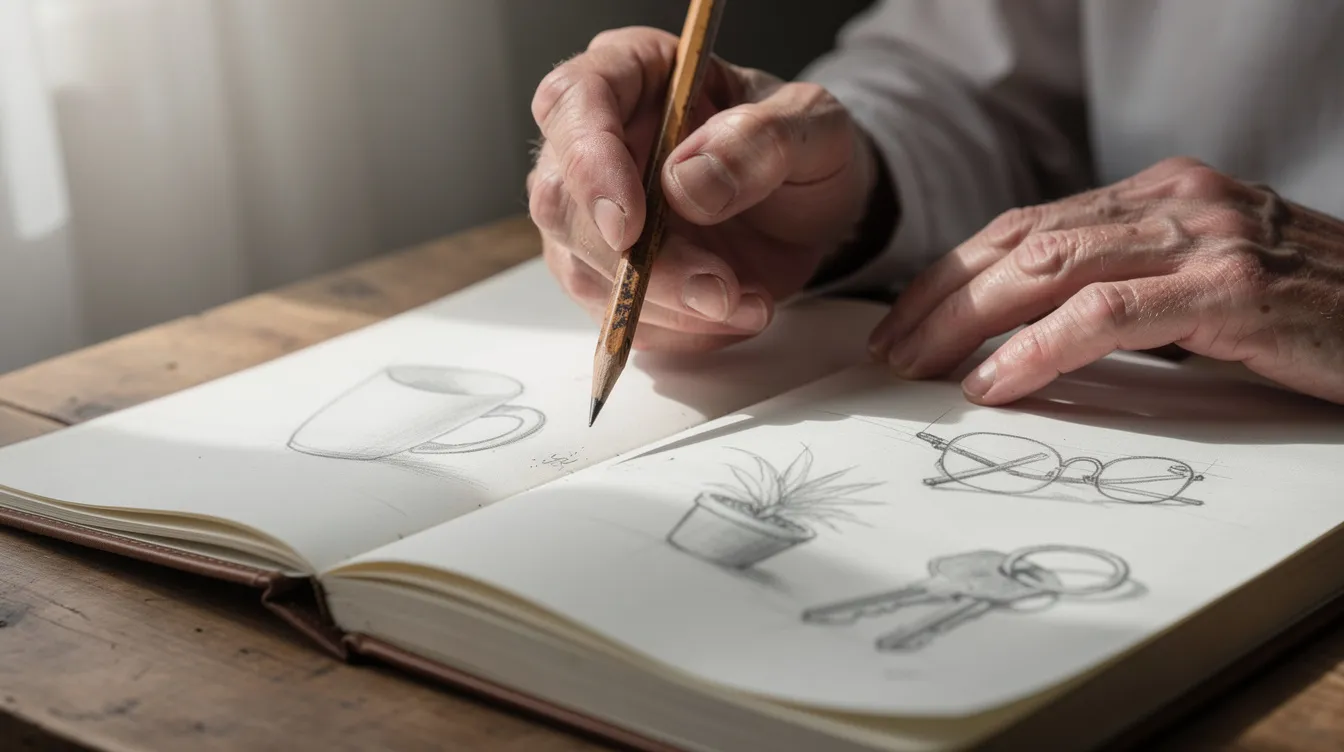
Mindset Shifts: From “Too Late” To “This Is My Time”
Before you start drawing, adjust how you think about the process. Otherwise frustration will make you quit early.
Focus on the joy of the process over perfect results. Draw because it is fun, and accuracy will follow. This matters most for adults used to being competent at work. After twenty years as a bookkeeper, being a beginner was a shock to me. I had to learn to look at medium-term improvement rather than short-term results, and that shift made all the difference.
This is not a race against young professional artists, and art is not a contest. The goal for a 52-year-old who wants to learn to draw is likely enjoyment, self-expression and mindfulness, not a 30-year commercial career. If you want a more detailed sense of the timing, see how long it takes to learn to draw. When you see young people posting photorealistic portraits online, remember that is a highlight reel, not everyday life.
Mistakes are how you learn, and they are a normal part of the learning process. Re-label them as information: every “bad” drawing is a data point, not a verdict on your potential. Young kids draw without judging the result, and that is the attitude to borrow. Nobody frames their piano scales or their first coat of paint, so treat early drawings as play, not performance.
Two simple habits that helped me:
-
“I will allow myself ugly sketches for six months.”
-
“I will compare this month’s drawings only to last month’s.”
Can Adults Really Learn To Draw Without “Talent”?
Almost every email I receive at The Hobby Artist contains the phrase “I have no talent.” I could have written the same email myself. But here is the difference between natural talent and what actually matters: natural sensitivity, like noticing subtle shades, gives you a small head start. The trainable skills of observation, measuring and controlling the pencil are what produce drawings. And all of those can be taught, so adults can learn to draw without any special gift.
What most people call talent is usually early practice. Adults are comparing their first month to someone else’s tenth year. Drawing breaks down into seeing shapes, measuring proportions and handling values. Teenagers develop a critical eye for studying technical proportions and perspective, and that skill keeps developing well into adulthood. Adult beginners often progress faster in understanding composition and concepts than kids do, because life experience substitutes for some of that perceived innate talent. Adults often bring better focus and emotional depth to drawing than children do. They are better at analysing references, following structured courses and sticking with unglamorous exercises. They also know how they learn best, and they tend to be interested in why a drawing works, not just whether it looks right.
Talent may influence speed and style, but consistent practice, plain hard work and clear feedback matter far more than whatever natural talent you did or did not show as a child. For more on why almost anyone can pick it up, see why anyone can learn to draw.
How Long Does It Take To Learn To Draw As An Adult?
Think in months and years, not days, but expect noticeable progress surprisingly early if you draw regularly. With dedication you can learn to draw at any age, and the timeline depends on how often you show up.
Here is what I have seen, roughly, for someone who can find 20 to 40 minutes most days:
|
Timeframe |
What to Expect |
|---|---|
|
1 month |
Lines get steadier. You start seeing shapes instead of things. |
|
3 months |
You can shade a simple form so it looks round. The blank page stops feeling scary. |
|
6 to 9 months |
Still lifes look convincing. Faces turn out to be hard. |
|
1 year |
People start asking if you took classes. |
|
2 to 3 years |
Confident drawing from life. Your own style begins to emerge. |
It takes about 1,000 hours to learn to draw well. If you draw for 10 hours a week, that is 1,000 hours in about 2 years. Many artists improve significantly within 3 years. For the curious, it takes roughly 10,000 hours to become an expert, but you do not need to be an expert to enjoy it or to create work you are proud of.
Progress is not linear. Plateaus are common around the 6 to 12 month mark, when you suddenly notice how much you do not know. That is a good sign, oddly: your eye is improving faster than your hand, and now you know what to learn next. It is also where most people quit. Even great artists hit this wall. Push through it.
Adults often learn more efficiently than unsupervised children because they can choose good resources, follow a plan and reflect on their mistakes. Keep the timeline flexible, and do not measure yourself against anyone else’s calendar.
How To Start Drawing Today With What You Have
By the time you finish this section you will have a plan to draw something today with tools you probably own.
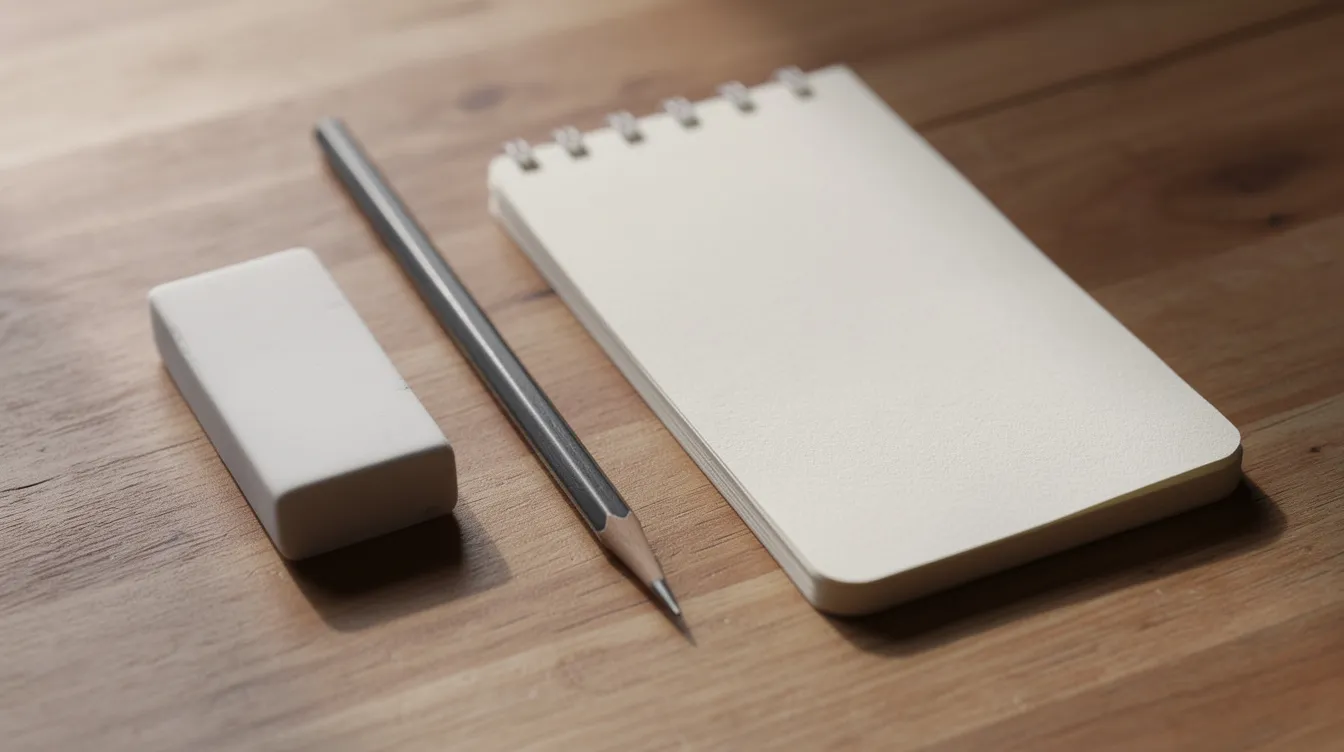
Your minimal toolkit:
-
An HB or 2B pencil
-
A cheap sketchbook or sketch pad
-
An eraser
That is it. In the beginning I used a cheap sketchbook and a pencil from a drugstore. Gear is a fun way to avoid sitting down to draw. Play with what you have first, and commit to filling one whole sketchbook before upgrading a single thing.
Your first session:
-
5 minutes: Play with loose lines and circles to warm up. A straight line, a wobbly circle, another straight line. Do not judge them. It is supposed to be fun.
-
10 minutes: Draw a nearby object, a mug, a shoe, your own hand. Real objects like these teach you to see in a way photos do not.
-
5 minutes: Reflect on what was hard. Proportions? Shading? Where your hand met the page?
Learning to draw involves observing shapes and proportions in real objects. That is what this first session trains. For a broader walkthrough of those first steps, read a full beginner walkthrough.
Write the date on the first page and date every page after it. Your first lopsided mug is not a sign that you lack talent. It is the baseline. In three months, flip back. That comparison is the best motivation you will get.
Building A Sustainable Drawing Habit Around A Busy Adult Life
I have a full time job. I had thirty minutes after the dishes, not two hours after school. The fix is consistency over volume. If you are wondering how to find time to draw with a full-time job, I wrote a separate post on how to find time to draw with a full-time job.
Draw every day if you can. Short, focused sessions of 20 minutes work, and 15 to 20 minutes a day beats less frequent longer sessions. Frequency beats session length every time. Twenty minutes five days a week beats two hours on Sunday, because hand and eye learn through repetition spread over time.
Find triggers that play well with your routine:
-
Draw after morning coffee
-
Sketch during a lunch break in the car
-
Draw while the evening news is on
Treat it like brushing your teeth: a small, non-negotiable discipline that does not depend on feeling inspired. Most artists I know keep a sketchbook within reach for exactly that reason. Put a time on the calendar and protect it the way you protect a meeting.
What To Practice First When You Learn How To Draw
When I decided to learn how to draw properly at 44, I followed a beginner course in order instead of guessing, because a sequence saves months. Here are the skills to focus on for the first 6 to 12 months, and if you learn them in order you will not feel lost:
-
Line control: How to draw lines steadily and control pressure. Basic shapes like straight lines and circles are foundational skills in drawing.
-
Basic shapes: Boxes, cylinders, spheres. Break complex forms into simple ones.
-
Proportion: Measuring, comparing sizes, using negative space.
-
Simple shading: Light source, cast shadows, making forms look three-dimensional.
-
Observation over memory: Draw from life, not from your head. Life drawing, even of a coffee cup, trains the eye far better than imagination at this stage.
A simple week might look like this: a couple of sessions on lines and shapes, a couple of life drawing sessions with mugs and houseplants, and one session copying a drawing or photo for accuracy. Repetition is normal. Draw the same cup or plant many times. Skip complex anatomy and perspective until you are comfortable with the basics. If you later want to paint, the same skills of seeing shapes and values carry straight over.
For the fundamentals, I found great help in structured courses that cover lines, shapes and shading without assuming you drew as a child. Find one resource and stick with it for months. If you are interested in a structured path, I am a genuine fan of the drawing foundations for adult beginners lessons from Lisa’s drawing academy, which take lines, shapes and shading one step at a time.
Using Modern Tools And Resources As An Adult Learner
Learning art is far easier logistically than it was in the 1980s or 1990s. Online videos, drawing apps and communities mean you can learn how to draw at your own kitchen table, and good resources are cheaper and easier to find than at any point in history. On The Hobby Artist I stick to simple, low-pressure routines and encourage you to combine them with whatever you enjoy. Many adults do best with a structured online course at their own pace, so they learn the fundamentals in order, plus drawing from life on their own.
Digital tablets offer undo, zoom and no clutter, which can reduce fear for some beginners. But a pencil and paper are cheap, portable and need no charging. Either works. The discipline matters more than the device.
Choose one or two main courses and stick with them for 2 to 3 months instead of hopping between dozens of tutorials. Depth beats breadth at the beginning.
How Learning To Draw Benefits Adults Beyond The Sketchbook
Drawing has improved my patience, my observation and my ability to slow down. It came into my life the fall my daughter left for college, and it became a quiet passion that filled a space I did not know was empty. I still learn something new every week.
Benefits that matter for adults:
-
Stress and rest: Engaging in creative hobbies enhances neuroplasticity and reduces stress later in life. Making art is quiet time away from screens and the rest of the world.
-
Sharper thinking: Learning to draw can improve decision making and focus. Every stroke is a small choice about length, value or direction, and those choices add up.
-
Social connection: Local sketch groups, sharing drawings with friends, your kids or young grandchildren, and sketchbooks as a visual diary of everyday life.
-
A life of observation: You start to notice light, form and texture everywhere, from the shadow under a mailbox to the paint peeling on a fence, and you want to draw it. The world looks different when you pay attention.
Some readers move on to watercolor or oil paint after a year of pencil work, and what they learned about shapes and values carries over. Even if you are only mildly interested in art and never become one of the professional artists you admire, the quality-of-life gain is reason enough to start learning now.
Final Thoughts: Your Next Year Of Drawing Starts Today
I began taking drawing seriously as an adult with no passion for art, no background, no sign that I could draw. If I could show my beginner self the sketchbooks I have now, the only thing I would change is that I wish I had started at a young age, though I am glad I started at all.
It is not too late. Not at your age, not at your skill level, not with your schedule. Age, talent and past experience are less important than whether you draw regularly from now on. The rest is just showing up.
Here is your action for today: start drawing the object nearest your hand for 10 minutes. Write the date on the page. If you like, post a photo of it in a sketching group for encouragement. Do it again tomorrow. A year from now you can have a stack of filled sketchbooks or another year of waiting, and The Hobby Artist exists to help with the first option.
Drawing is not a race you are late for. It is a lifelong companion you can still meet. If you take one thing from this post, let it be that. Stay open to the idea that this is your time, and the same place you are sitting right now can be where it all begins.

FAQ
Is it too late to learn to draw at 50?
No. People learn to draw in their fifties, sixties and later. Research with adults aged 65 to 87 showed measurable improvement in drawing skill after structured practice. You may need a bit more patience at the start, but the skills are the same ones a twenty-year-old learns. Being a bit older is not a time limit, and it does not matter that you are starting late.
Can you learn to draw if you have no talent?
Yes. What looks like natural talent is usually early practice. Seeing shapes, measuring proportions and handling values can all be taught. I am living proof, and so are most of the artists in my sketching group.
Should adults take an art class or teach themselves?
Either works. If you are interested in a class, a structured course speeds things up by giving you a sequence, so you learn clear fundamentals and why things work. Pair it with drawing from life on your own. Many adult students do well with a hybrid approach: one good course plus a daily sketchbook habit.
How often should an adult beginner practice?
Aim to draw most days of the week, for around 15 to 30 minutes. Drawing requires regular practice to develop skills effectively, and frequent short sessions build skill faster than occasional long ones. Five days a week is a good target that fits around work and family.