

Yes. Anyone can learn to draw, including you, even if you work full time and think you have zero talent. There are a few real exceptions, and I will be honest about them later, but they are narrower than most beginners fear. Drawing skills are learned skills, not a genetic lottery, and practice matters more than natural talent.
Answering the Big Question Up Front
My name is Paul. I kept the books for a freight company for twenty years and picked up a pencil at 44, the fall my daughter left for college. I used to say “I can’t draw” the way other people say “I can’t dance,” as if it were a statement of fact baked into my bones. A few years at a kitchen table proved me wrong.
Drawing is a learned motor and cognitive skill. Drawing skills can be developed at any age or skill level, and neuroplasticity allows adults to develop drawing skills throughout life. Research backs this up. A randomized controlled trial with older adults who had no formal art training found that after a six to eight week program, their drawing test scores rose from an average of 6.08 to 8.24. These were people in their 60s and older, starting from scratch, seeing measurable gains. Another study found improvements equivalent to about 0.45 standard deviations in drawing accuracy compared to a control group, which is a moderate effect, meaning real, visible improvement from modest practice.
Now, I am not going to tell you that you will become a world-famous painter. That would be dishonest. But becoming good enough to enjoy drawing confidently at home, to sketch a friend’s portrait, to fill a sketchbook you are proud of? That is very realistic. The rest of this article shows how, even with a busy schedule.
Why Drawing Looks Like Magic (But Isn’t)
Most of us stop drawing around age 10 to 12. After that, we spend decades not practicing, and when we finally try again as adults, our drawings look like a child’s. This creates the myth that “I just can’t draw.” But the problem is not ability. It is rust.
Here is what happened to me. My early sketchbooks were full of flat anime eyes and lopsided heads. I was drawing what I thought an eye looked like, not what was actually in front of me. Most beginners draw symbols instead of actual shapes and angles. We draw a leaf shape for an eye, a circle for a head, a stick figure for a body, because those are the symbols we learned at age eight and never updated.
Drawing is 80% about learning how to see and 20% about hand-eye coordination. When I started studying fundamentals, I realized that an eye is not a leaf. It is a collection of specific shapes, curves, values, and proportions that change depending on the angle and the light. Once I learned to observe those things instead of relying on my childhood symbols, my drawings started looking like the objects in front of me.
Realistic drawing is a learnable skill. It operates on rules: perspective, light, and shadow, proportion, value. These rules can be learned like basic algebra. What looks like natural talent in a good artist is usually hundreds of hours of unseen practice and study of fundamentals. I started with no art background and no talent to speak of. The difference between my first sketchbook and my fifth is not magic. It is time spent learning to see.
Natural Talent vs Hard Work: What Really Matters?
Does natural talent matter in drawing? Some people do pick it up faster. Kids who draw constantly and get praised for it develop an early comfort with a pencil. But a head start is not a ceiling. Talent may shave off time in the early stages, yet it never replaces deliberate practice or decides whether you can learn how to draw.
I had a coworker who told me he had “no talent whatsoever.” He started doing 20-minute daily sketch sessions in January. By June, his improvement was obvious. His lines were more confident, his proportions more accurate, his shading more convincing. Meanwhile, I have met people who consider themselves naturally artistic but draw sporadically, maybe once a month during a burst of passion. After a year, the consistent person had pulled well ahead.
Effort distinguishes great artists from beginners, and what predicts improvement is not early talent but consistency: how often you practice, whether you focus on fundamentals, and whether you seek feedback. In one study, participants who improved the most (averaging a four-point gain on a drawing test) had similar starting scores to those who barely improved. The difference was engagement and time spent on focused exercises.
For adults with jobs and families, a small, regular habit beats waiting for inspiration. Starting late costs you time, not ability. If you are still wondering is it too late to learn to draw, I explored that question in its own post.
What Does It Mean To “Learn To Draw” As An Adult?
You are not signing up for a four-year art degree. You are building a lifelong skill. The realistic end goal for a busy person is being able to draw portraits of friends, sketch a simple urban scene from life, or keep a satisfying sketchbook. There is a difference between a professional artist level and a confident hobbyist level, and the second is reachable through structured practice.
Every individual improves at different speeds based on their unique learning process. But here is a rough timeline: about three months to feel comfortable with basic shapes, six to 12 months to see clear improvement in proportion and shading if you practice around 30 minutes a day. Noticeable improvement appears in weeks if you practice with intention. Proper instruction combined with practice unlocks drawing ability.
As an adult, you bring advantages a teenager does not have. Patience. The ability to follow complex instructions. A lifetime of visual experience that gives your drawings meaning. You also bring subjects you care about: your house, your family, places you have been. Not everyone ends up at the same level, and that is fine. The realistic question is whether you can draw well enough to enjoy it and show a friend. The answer, for almost everyone, is yes.
The Core Drawing Skills Anyone Can Learn
There are about six foundational skills that unlock every drawing subject, and learning to draw requires knowing what to learn in order. None of them is mystical. Each can be trained with simple, repeatable exercises at the kitchen table. Good drawing is about learning to observe proportions and break down shapes.
-
Seeing in simple shapes. Breaking objects into simple geometric forms aids in drawing. A coffee mug is a cylinder. A car is a stack of boxes. A tree trunk is a cylinder topped with a rough sphere. Focus on basic shapes before adding details or shading. Once you see these forms everywhere, different subjects get much easier to depict.
-
Proportion. Understanding proportions is crucial for accurate drawing of objects. This means comparing lengths and angles. For example, in a human face the eyes sit roughly halfway between chin and top of skull. It is measuring, and measuring is a learnable skill.
-
Perspective. Parallel lines appear to converge toward a vanishing point. One-point and two-point perspective let you draw desks, streets, and rooms that look like they have real depth. This is a rule, not a talent.
-
Values and light. Understanding light and shadow is essential for creating depth in drawings. Learning to see and shade five simple tones from light to dark makes flat shapes feel three-dimensional. A sphere becomes convincing the moment you add a highlight, a midtone, a shadow, and a cast shadow.
-
Line control. Drawing a straight line, a confident curve, or varying pencil pressure to create thick and thin marks. Steadier hands come from repetition, like handwriting. Nobody is born writing in cursive.
Realistic drawing is a learnable skill for everyone. These five areas plus colour theory for those who move into painting later make up the core toolkit. Practice observing real objects rather than drawing from memory, and the skills build on each other.

Not All Practice Is Equal: How To Make Progress Faster
Doodling absentmindedly will not transform your drawing skills, even if you clock many hours. Effective practice requires focused effort, not just time spent drawing. There is a difference between passive drawing, copying images without thinking or half-sketching while scrolling your phone, and active, focused practice where you engage your mind.
Focused practice looks like this: one specific skill per session. Twenty minutes of only boxes in perspective. Five three-minute gesture drawings of your hand. A page of circles and ellipses to train hand control. Effective exercises are essential for practicing drawing techniques, and identifying and targeting specific weaknesses can enhance your drawing skills faster than repeating what you already do well.
I tried Drawabox, a free, exercise-based course, early on. My first lesson’s boxes were crooked and my ellipses were worse. But when I repeated the exercises over a few days, the lines got straighter. That was proof that the drawing process is drills, not a gift. Using structured guides can help beginners improve their drawing skills, and engaging your mind during practice enhances skill development.
Keep a simple practice log with dates and brief notes. It does not need to be fancy. A line in a notebook: “Tuesday, 20 min, boxes in two-point perspective, still wobbly on verticals.” This builds proof of progress over months and helps you figure out where to focus next.
Effort is more important than time spent practicing drawing. Fifteen to 30 minutes of deliberate practice, four or five days a week, outperforms random marathon sessions once a month. Consistent practice is essential for improving drawing skills.
Designing a Realistic Drawing Routine Around a Busy Life
Time is the constraint that affects most adults. I will be blunt: you cannot learn to draw without spending hours at it, and ten minutes a week means slow progress. That is just arithmetic. But you do not need hours a day. You need regular, short sessions. If your schedule is the real obstacle, how to find time to draw with a full-time job has more ideas.
Making a specific drawing plan increases the likelihood of practice. Psychologists call this an “implementation intention.” Instead of “I should draw more,” you decide: “I will draw for 25 minutes at 8:30 pm at the kitchen table after the kids are in bed.” Research suggests this kind of specific plan increases follow-through two to three times compared to vague goals.
Here are three sample routines:
-
9-to-5 office worker. Three weekday evenings plus one weekend morning. Twenty minutes each. Total: about 80 minutes a week.
-
Shift worker. Two sessions on days off, one short session before a shift. Fifteen to 25 minutes each. Total: about 60 minutes a week.
-
Stay-at-home parent. Five short sessions during nap time or after bedtime. Fifteen minutes each. Total: 75 minutes a week.
Regularly practicing for short periods can be more effective than longer sessions. Start with three sessions a week in the first month. Practice regularly and consistently to improve drawing skills, and add sessions as the habit sticks.
Keep your tools simple to lower friction: a cheap A5 sketchbook, a 2B pencil, and an eraser, all kept in the same spot. If you have to hunt for supplies, you will skip the session. And when you miss a day, treat it as data, not failure. Adjust the time slot rather than abandoning the habit. Lapses are normal. What matters is coming back.
Common Fears That Stop People From Learning to Draw
The emotional side of learning to draw is just as real as the technical side, and it stops more people than a lack of skill ever does.
Fear of being too old. Many of my readers started drawing in their 40s or 50s and still saw big improvement by sticking with it for a year. Studies confirm that older adults, including people in their 60s and 70s, still show gains in perceptual, motor, and visuospatial skills with structured drawing practice. Your age is not a wall.
Perfectionism and comparison. Dedicate one “ugly sketchbook” purely for practice and experiments. Every artist has thousands of sketches behind them that are not perfect. When you scroll through social media and see flawless drawings, remember you are seeing someone else’s best one percent of work. Early drawings feeling awkward is not proof you lack talent. Mistakes are an integral part of the learning process in drawing, and each bad drawing is a data point that shows what to work on next, not a verdict on your potential. If comparison is what stings most, I wrote about ways to stop comparing your art to other people’s work.
Aphantasia. Some people cannot form mental images at all, a condition called aphantasia. Drawing from imagination is harder for them, but drawing from observation does not need a mental picture. Research on identical twins, one with aphantasia and one without, found that when drawing from reference, their performance was similar. People with aphantasia learn to draw well by leaning on reference material.
Tremor and motor difficulties. Physical limitations like essential tremor or arthritis are real obstacles, not excuses. Many people adapt by drawing larger, using a thicker pencil, bracing the wrist on the table, keeping lines short, or choosing a looser style. A doctor or occupational therapist may have more ideas. These adaptations do not eliminate the challenge, but they make progress possible.
Proof That Anyone Can Learn to Draw
Belief grows when we see proof, not just hear encouragement. Over 1,000 students across various drawing programs have improved their drawing skills significantly with structured practice, and research consistently shows that anyone can learn to draw with focused effort.
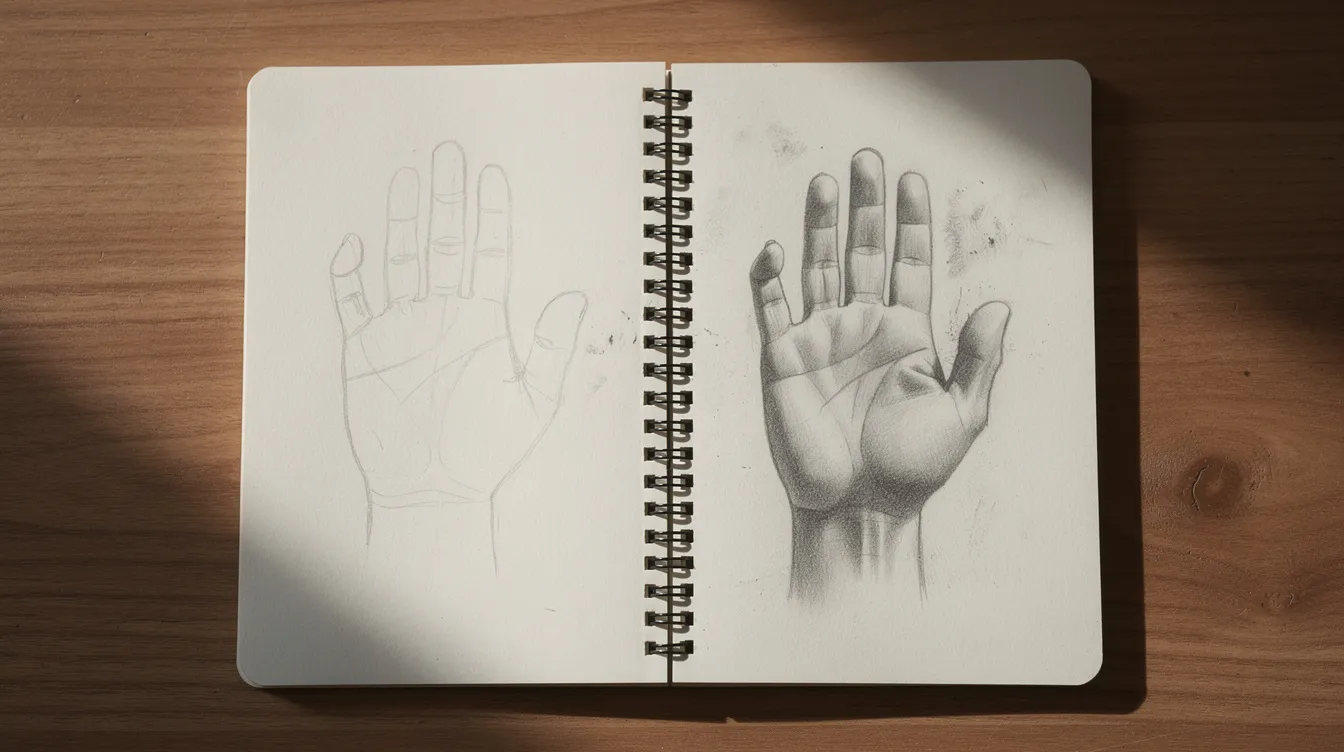
I have my own mini before-and-after. A sketch of a hand from my first year looked like a rubber glove. Flat fingers, no knuckles, no sense of light. A sketch from a few years later shows joints, tendons, and a clear light source. Same hand, same person, different amount of practice.
The adult learners I know best are from my local sketching group. Most started after 40: a retired nurse, a long-haul trucker who began because he was tired of staring at his phone in motel rooms, a dentist, two grandmothers. None had art training. Their styles differ. The nurse is careful and slow. The trucker is fast and loose. What they share is that they kept showing up. One of them started with regular 20-minute sessions and within two years could create simple urban sketches from life that any person would recognize and enjoy. Many beginners can create impressive work with proper guidance.
Tracking progress by comparing past drawings can motivate improvement. Flip through old sketchbooks. Look at phone photos dated months apart. Day to day, progress is invisible. Across weeks and months, it is unmistakable. Improvement is a reliable result of focused effort, not a rare gift reserved for a lucky few.
How To Start Learning to Draw This Week
Here is a simple test. Draw a mug today, as well as you can. Date it and put it away. Practice for four weeks. Then draw the same mug again and compare. You will see the difference.
For a seven-day starter plan, try this: each day, draw one household object using only simple shapes and light shading. Pencil and paper only, so the focus stays on skills, not materials.
-
Day 1: a mug
-
Day 2: a shoe
-
Day 3: a plant
-
Day 4: your phone
-
Day 5: a spoon
-
Day 6: a chair
-
Day 7: a book
Set a timer for 15 to 20 minutes per object. The timer keeps sessions approachable and prevents overthinking. Take a quick dated photo of each drawing so you can compare lines and proportion even within one week.
If you enjoy the first week, you can explore more structured practice on fundamentals like perspective and value in the coming months. There are online courses and tutorials that teach these skills in order, which matters because learning to draw requires knowing what to learn in order. If you want a fuller roadmap, how to start drawing as an adult beginner walks through the early months step by step.
Enjoying the Process, Not Just the Results
Drawing is not only about the finished page. A 20-minute evening sketch after a stressful workday can act like a reset button, regardless of how “good” the result looks. Research shows that drawing engages attention, memory, and sensorimotor coordination, and that adults who draw regularly report relief, stress reduction, and a kind of quiet fun that is hard to find elsewhere in daily life.
Treat sessions as mini appointments with yourself, not tests. The win is time spent, not perfection. Try occasional fun prompts: a messy desk exactly as it is, people at a café, or your pet napping. These keep practice alive and prevent it from feeling like homework.
When you enjoy the drawing process, hard work becomes sustainable. And when hard work is sustainable, anyone can learn to draw over time.
Conclusion: Yes, You Can Learn to Draw
Anyone can learn to draw if they build basic drawing skills through steady, focused practice, regardless of natural talent. The real limits, like aphantasia or motor difficulties, are narrower than most people fear, and even those can be worked around.
You may not become a world-famous artist. But you can absolutely become a person who draws confidently and often. That is a new skill worth having. Pick a time this week for your first 15-minute session. Pick a mug or a shoe or whatever is sitting in front of you. Pick up a pencil. Date the page. If you are still deciding whether this hobby suits your life, the post on why drawing suits busy adults weighs the pros and cons.
I am a former bookkeeper who is still learning alongside you. My kitchen table still has pencil shavings on it most nights. The journey does not end. It just gets more interesting.
FAQ
Is drawing talent genetic? Some people may have natural advantages, such as good hand control or a strong visual memory, but there is no strong evidence that those advantages are required. A talented person may reach a baseline more quickly, but practice makes up much of the gap. Drawing is a skill, and like any other skill, it responds to effort.
Can you learn to draw if you were bad in art class? Yes. School art classes tend to grade the result instead of teaching the fundamentals in order. Many students leave thinking they cannot draw because nobody taught them proportion, perspective, or value. Learning the basics as an adult changes things a lot.
Can someone with a shaky hand learn to draw? Often, yes, with adjustments. Draw larger, use a thicker pencil, brace your wrist, keep lines short, or choose a looser style that works with the tremor rather than against it. A medical professional can advise if the tremor is severe.
How do I know if I am improving? Date every page and compare the same subject a month apart. Day to day, progress is too slow to notice, but it shows clearly across weeks. Expect the improvement to surprise you.