


I kept the books for a freight company for twenty years. I picked up a pencil at 44, the fall my daughter left for college, with no art background and no talent to speak of. What follows is what I learned about drawing every day while holding down a full time job. If you are just starting, my notes on how to start drawing as an adult beginner cover the basics.
Before You Try To Draw Every Day: What “Daily” Really Means
My first attempt at a daily drawing routine was in 2018. I decided I would draw for an hour every evening after work. I quit in nine days. The problem was not discipline. The bar was higher than my life had room for, and one missed evening felt like the whole plan had collapsed. I spent more energy feeling guilty than I ever spent with a pencil in my hand.
What finally worked was redefining “daily.” Drawing is a skill that can be learned regardless of previous experience or talent, but it takes showing up, and showing up means making it possible to show up. For me that meant accepting a few things:
-
“Draw every day” means most days of the week, not a perfect streak. A habit that only survives perfect weeks is not much of a habit.
-
Aim for 10 to 15 minutes of drawing daily. Compare it to the gym: short sessions most days beat a heroic four hour session once a month. Drawing for just five minutes counts as practice.
-
Daily drawing improves skills and accelerates progress, but protecting your creative energy matters more than chasing long streaks. Consistency beats intensity in practicing drawing skills.
-
For adults with jobs, kids, and responsibilities, a sustainable routine might be 5 to 15 minutes, or 4 to 5 days a week. Regular practice leads to quicker improvement than sporadic lengthy sessions.
Step 1: Decide Why You Want To Draw Every Day (And Write It Down)
One morning in January 2022 I almost quit for good. I had no clear goal beyond “be better,” and that is not enough fuel to get you through a Wednesday night when you are tired and the couch is right there. When I was honest with myself, my real reason in the beginning was simply wanting something of my own once the house went quiet. That reason carried more weight than any skill target.
A clear “why” carries you through days when you feel untalented. Drawing reduces stress and anxiety levels. It fosters personal growth and self esteem. Engaging in daily drawing brings joy and fulfillment. Those are not small things. Write your reason down.
-
Set realistic goals to maintain motivation and avoid burnout. Try concrete ones: “fill one A5 sketchbook by June 30,” “learn to draw faces from any angle by December,” or “use drawing as a 10 minute stress break every day.”
-
Choose one primary goal and write it on the first page of your dedicated sketchbook with the date. Something like “Goal for 2026: Draw 15 minutes every day to get comfortable sketching people on the train.”
-
I suggest having one skill goal (like learning perspective) and one life goal (like relaxing after work). The skill goal gives you focus. The life goal keeps it fun.
Step 2: Design A Daily Drawing Routine You Can Actually Keep
I treat drawing like brushing my teeth: same time, same place, tiny friction. My own daily minimum is five minutes, and a single page counts. That is the creative routine I protect. Draw for 10 to 30 minutes daily to build consistency, but start small.
Three sample routines you can literally copy:
-
Morning coffee sketch: 10 minutes between 7:10 and 7:20 a.m. at the kitchen table before work. Incorporate drawing into daily activities like commuting if mornings are impossible.
-
Commute sketch: drawing on the train or bus Monday to Friday in a pocket sketchbook.
-
Evening unwind: 15 minutes on the couch at 9:30 p.m. instead of scrolling on your phone.
The trick that made it stick for me: hang the habit on something you already do. It is useful to pair drawing with existing daily routines to build a habit. After dinner I clear the table, wipe it down, and sit with the sketchbook, so the wiping is the trigger and I never have to decide to draw. Write this sentence for yourself: “After I [anchor], I will draw for five minutes.” Repeating a small behavior in the same situation is what makes it automatic, which is why a tiny daily minimum beats an occasional big session in one sitting.
Keep drawing sessions flexible to accommodate busy schedules. Start small for the first 14 days, change nothing, and raise the time only if the habit feels easy. Set a phone timer so you can focus on the drawing and not the clock. If evenings are your problem, I wrote about how to find time to draw with a full-time job.
Step 3: Set Up Your “No Excuse” Drawing Corner
My drawing corner is nothing special: one chair, a lamp, a side table, and a shoebox of supplies in the living room. That is all in terms of stuff you need. The goal is to remove friction so you can sit down and draw within 30 seconds, even after a long evening. If the sketchbook is in a drawer upstairs, you will not do it. Leave it where the trigger happens.
A basic drawing kit includes pencils, erasers, and sketchbooks. Here is what I suggest:
-
One sketchbook you are not afraid to mess up, A5 or B5 size. Keeping a sketchbook normalizes the act of drawing in daily life. Choose acid free paper for archival quality.
-
Use graphite pencils with grades like HB and 2B for drawing. A pen if you like ink.
-
A kneaded eraser helps create highlights in your drawings. A basic sharpener.
-
Colored pencils in red and blue are useful for under sketching, though I did not discover this until my second year.
These are good drawing tools to start with. Keep them in a visible, grab and go container: a mug on your desk, a pencil case in your bag, or a tray by the sofa. Ergonomics matter even in short sessions: feet flat, and take a 10 second stretch every 10 minutes to protect your wrists and neck.
Step 4: What To Draw Every Day (So You Never Stare At A Blank Page)
In March 2020 I wasted 20 minutes just deciding what to draw and then ran out of enough time to actually practice drawing. The blank page won that round. After that I kept a prompt list and the problem disappeared.
Five categories that give you new ideas every week:
-
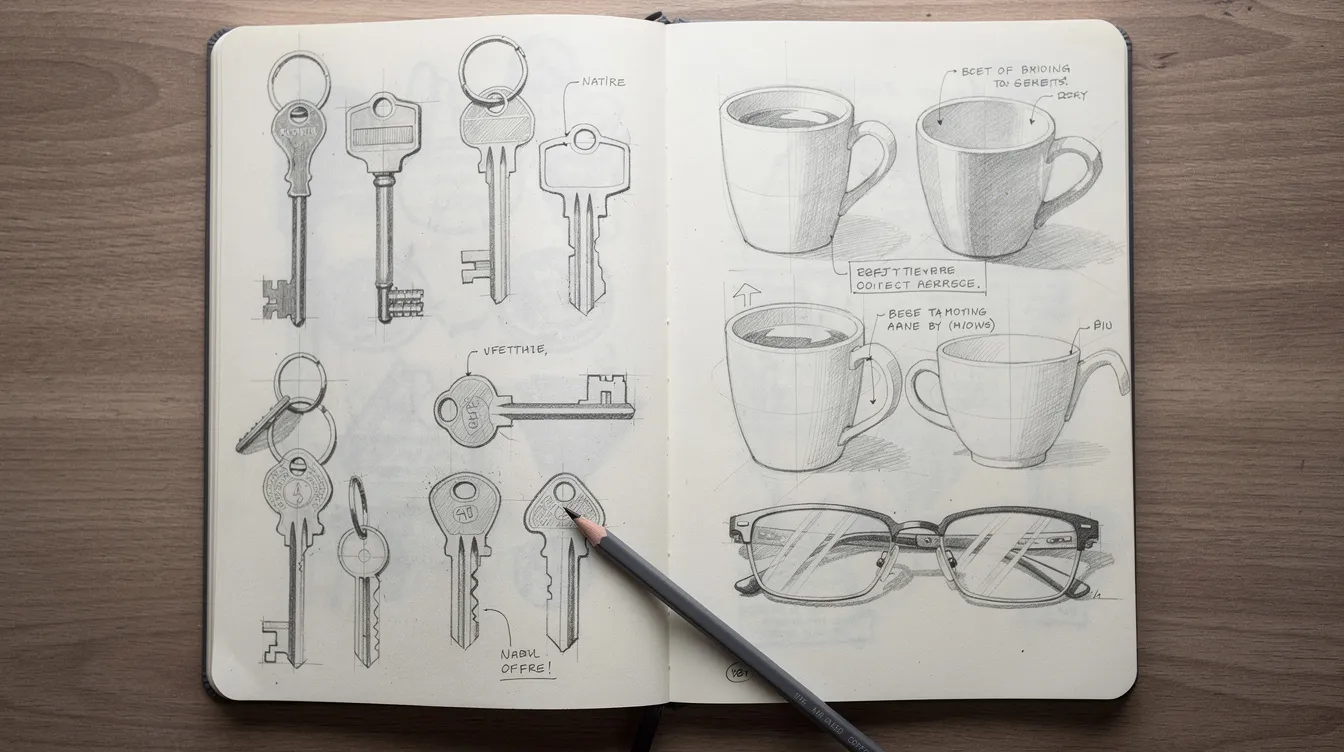
What is on my desk: keys, mug, phone, glasses, plant. Drawing from real life objects trains spatial awareness more effectively than photos. Sketching my coffee cup before drinking it became a default.
-
One room, one object: something different each day from the kitchen, bathroom, or hallway. Observational drawing teaches accurate representation of light and form using real objects.
-
People in motion: quick gesture sketches from commuters, workout videos, or sports clips. Life drawing in small doses. Gesture drawing captures the flow and proportions of a subject.
-
Tiny studies: eyes, noses, hands, or folds of fabric, filling a paper page with variations. Deliberate observation involves analyzing negative space and light falloff.
-
Memory and imagination: draw something from your day, like your lunch or a conversation.
Use prompts to overcome creative blocks. Keep a prompt list at the back of the sketchbook and add to it every Sunday. Examples: “draw your shoes,” “draw your breakfast on April 10,” “draw your hand holding a spoon.” Optional monthly themes like “April 2026: 30 days of drawing plants” add focus and challenge you with unfamiliar subjects.
Art routines should include both technical practice and observational drawing to enhance skills. Studying the masters helps to reverse engineer techniques and composition choices. It is fine to copy a drawing you like for practice and not for show. Copying is how artists have learned for centuries. Regular structured practice improves drawing skills more than random doodling.
Step 5: Use Quick Warm Ups To Make Daily Drawing Feel Easier
I rarely jump into a “serious” sketch. Most days I begin with 2 minutes of lines and shapes to wake up my hand and my brain. Regular drawing enhances cognitive function and mindfulness, and warm ups are where that process starts.
Simple exercises that develop line control and muscle memory by practicing lines and shapes using the whole arm:
-
Fill half a page with straight lines in different directions, trying to keep them parallel.
-
Draw circles and ovals of different sizes for one minute without worrying about wobble.
-
Make rows of boxes shaded from light to dark with hatching. Practicing shading and value scales improves contrast and depth in your drawings.
-
Practice quick 20 second gesture drawings from photos or video.
Warm ups are perfect for days of resistance: even 2 minutes of circles “counts” and keeps the chain unbroken. On those days, scribbling spirals or tracing your hand works too. Embracing mistakes is essential for developing a daily drawing practice, and warm ups are low stakes enough that nothing can go wrong. A beginner friendly drawing routine like this can help build confidence and skills. Structure it as 2 to 5 minutes of warm up, then the rest of your time on one small drawing. If you want more options, see these beginner drawing exercises for your next session.
Step 6: Three Daily Drawing Routines To Choose From (And Mix)
Different seasons of life need different routines. I cycle through these three over the year.
|
Routine |
Days |
Session length |
Best for |
|---|---|---|---|
|
10 Minute Every Day |
Most days |
10 min |
Busy weeks. Minimum viable: one tiny doodle or just ten minutes of lines. This is where I live most of the year. |
|
Two Day Intensive |
2x per week (e.g. Wednesday, Saturday) |
45 to 90 min |
Deeper study of one subject like portraits or perspective. Drawing twice a week is better than inconsistent daily practice. |
|
30 Day Challenge |
Daily for one month |
15 to 20 min |
A fixed topic like “buildings in perspective.” Rest the week after. |
Daily drawing schedules can improve skills while adding variety to practice. Incorporate light drawing days to maintain the habit during heavy weeks. Short, effective practice sessions yield better results than longer, unstructured drawing marathons. Start with the 10 minute daily drawing practice for one month and add a weekly intensive in month two. Raise the minimum only once you are surprised to realize you routinely draw longer than it, and nudge it up gently, so you do not fall back into the all or nothing trap. Mastering fundamentals includes practicing perspective and anatomical structure, which fits naturally into the intensive sessions.
Step 7: Track Your Daily Drawings So You Can See Real Progress
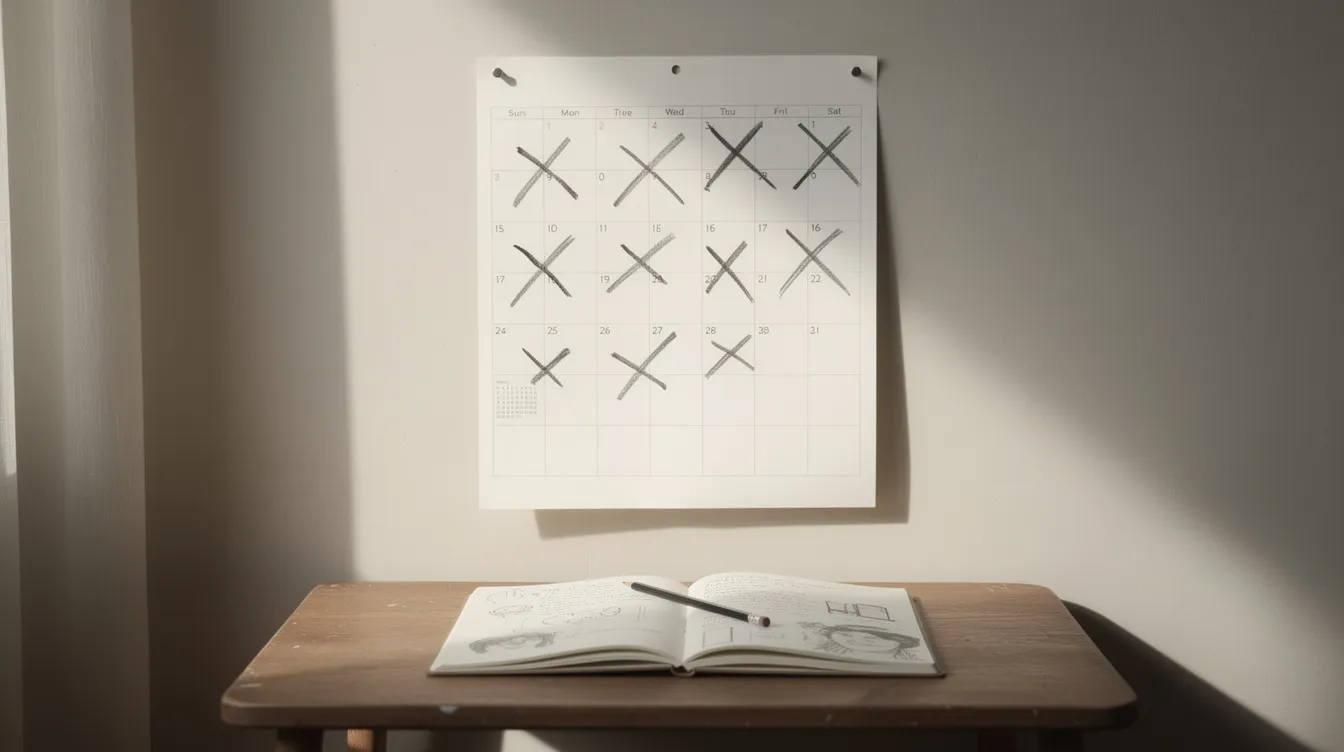
In 2019 I hung a calendar on the fridge and crossed off each day I drew. Seeing 23 Xs in a month changed my motivation more than any post or pep talk. Tracking daily drawing activities can aid in maintaining consistency in practice.
-
A wall calendar with an X for every single day you draw, even if it was only 5 minutes. I tried an app and ignored it within a week. The paper calendar on the fridge works because I walk past it.
-
A bullet journal habit tracker with a tiny colored square for each day.
-
Numbered sketchbooks with start and finish dates on the inside cover.
I keep every page and date it. Recording progress by dating drawings helps track development over time. After several months, flipping back is a better reason to keep going than any streak counter. Take monthly snapshot photos on the 1st to see improvement in line confidence and proportions. Review and critique older work to identify growth areas and celebrate progress. Celebrate small wins to stay motivated, because the learning process is long.
Art education can help with personal development and adult learning. Do not expect fast results. It took me a few weeks to stop wincing at my own pages, and a couple of months before sitting down felt automatic. Be patient.
Step 8: How To Stay Motivated When You Miss Days Or Hate Your Drawings
In September 2021 I skipped an entire week. I felt like I had “failed” as an artist. I restarted with 5 minute sessions and the routine came back within days. The moment I stopped punishing myself for the gap, the gap stopped being a problem.
-
Missing one or two days does not break the habit if you start again the next day. Write “never miss twice” on the inside cover of the sketchbook. After a missed day, even a single line keeps the chain alive.
-
Some drawings will look bad, especially when you are tired. On very bad days I have drawn my shoe, and it looked like a loaf of bread. I dated the page, closed the book, and the chain held. Lower the bar, do not cancel.
-
End each session with one sentence about what went well. Feedback and self reflection are important in recognizing artistic growth. Keep a “favorite drawings” envelope with one pick a week. Flip through the sketchbook once a month to spot small improvements.
-
Balance discipline with fun: once or twice a week, draw something silly or relaxing, like cartoons or doodles from your imagination. Drawing daily helps improve skills and creativity over time, but only if you do not burn out first. Setting small, achievable goals fosters a sustainable drawing habit.
Avoiding comparisons to professional artists encourages personal progress tracking. Your rough sketch after a long day is not the same creative activity as someone’s 20 hour painting. Keep that in perspective. For a realistic sense of the timeline, see how long it takes to learn to draw.
Step 9: Use The Art Community (Without Comparing Yourself To Death)
In 2020, online communities helped me stay motivated and gave me inspiration. They also made me compare my rough daily drawings to polished portfolios, which nearly killed the habit. The art community is valuable for accountability, encouragement, and fresh ideas for what to draw everyday, but you have to use it carefully. I have also looked at paid programs like Sketchbook Skool, which looks interesting, though I have not tried it.
-
Find one supportive space for your stage: a small forum, a local sketch group, or the comments on beginner friendly blogs like The Hobby Artist.
-
Share one sketchbook page a week instead of daily. Join low pressure challenges like “7 days of drawing objects on your desk.” Ask for feedback on one specific skill.
-
Follow artists who share process and beginner work, not just finished masterpieces. Hope comes from seeing someone a few steps ahead, not a hundred.
As adults our art time is limited and precious. I still draw most evenings at the kitchen table, the same spot where I started at 44. Daily drawing, even briefly, is a powerful way to reclaim a piece of your life that is just yours. Pick up the pencil. You will be surprised how far a few minutes a day can take you.
FAQ
Is it necessary to draw every single day?
No. Four or five days a week still builds skill. The daily habit is mostly a trick to remove the decision about whether today is a draw day. Rest days are fine as long as they stay rare. Develop the routine and the rest takes care of itself.
How long does it take to form a drawing habit?
It varies, and I would not trust anyone who gives an exact number. For me it was a couple of months before sitting down felt automatic. Research on habit formation suggests a wide range. Keep the minimum small and be patient with yourself.
What if I miss several days in a row?
Restart today with the tiny minimum. Do not make up for lost time with a big session, because the goal is to restart the routine, not repay a debt. One page, one sketch, five minutes.
What should I draw if I am bored?
Switch subjects: objects in another room, your hand in different poses, or the view from a window. Boredom usually means the subject is stale, not that the habit is wrong or not working.