

I kept the books for a freight company for twenty years and picked up a pencil at 44, the fall my daughter left for college. I had no art background and no talent to speak of. So when I say these numbers come from someone who started late, with a day job and zero formal training, I mean it literally.
Answering “how long does it take to learn to draw?” right away
Here is the short answer. A complete beginner who practices 20 to 30 minutes a day can usually draw simple, recognizable objects in about three months. Reaching a comfortable intermediate level, where friends recognize most things you sketch and you can draw from life without wanting to hide the paper, takes one to two years of consistent practice. Learning to draw is a skill that can be developed with intentional practice, and artistic skill development progresses gradually through defined milestones.
“Getting good” is a moving target. Hobby-level competence lands around one to two years. Professional illustration or concept art skills often take five to ten years of serious work. The time it takes to achieve drawing proficiency varies from person to person, and artistic growth may take from six months to over two years depending on commitment and practice quality. It takes about four months of daily practice to begin seeing real improvement, and most learners reach intermediate level in one to two years.
The rest of this post covers what affects that timeline, the first step you should take, and how adults with full-time jobs can make real progress without pretending they have art school schedules.
What do I actually mean by “learning to draw”?
When I say “learn to draw,” I mean something concrete: being able to draw everyday objects, a chair, a mug, a corner of a room, a tree, so that a viewer can identify them without a label. Learning to draw includes understanding shapes, proportions, perspective, and shading. The four fundamentals of drawing are proportion, value, edges, and color. Different subjects require different drawing skills and competencies, but those fundamentals run through all of them.
I break the path into three rough stages. In the beginner stage, from zero to about three months, you are doing simple line drawings from photos and basic still life. Your lines are shaky and your shapes lean. That is the plan working, not evidence of failure.
In the early intermediate stage, roughly three to twelve months, you begin basic shading, simple perspective, and sketching what you see around the house. You can notice when a drawing is off even if fixing it is hard.
In the intermediate stage, one to two years and beyond, you start combining observation with imagination, drawing simple scenes and small urban sketches with some confidence.
Polished portraits, complex cityscapes, figures in dynamic poses, and even animation work come after this foundation. My own finish line was never a masterpiece. It was a mug on my desk that my family recognized. That is what I mean throughout this post. Sketching should prioritize communication over perfect reproduction. Most hobbyists I know are happy once looking, shading, and proportion click, and portraits and drawing from imagination can wait.
What really affects how long it takes to learn to draw?
Five things matter more than anything else:
-
Frequency and consistency. Twenty minutes every day beats three hours once a month. Consistent practice helps improve drawing skills more effectively than occasional long sessions, and regular short practice sessions are more effective for skill building than infrequent longer sessions.
-
Quality of practice. Focused exercises on fundamentals vs doodling the same anime face for years. Quality of practice matters more than hours spent drawing.
-
Guidance and feedback. Books, a course, classes, an online critique group, or even a friend who draws. Knowing what is wrong speeds everything up.
-
Your starting point. A person who doodled comics as a teen has some hand-eye coordination already. A complete beginner faces a steeper early curve.
-
Life constraints. A full-time job, kids, limited energy after work. Finding time to draw with a full-time job is the real bottleneck for most readers, and practical habits for fitting practice in matter more than grand ambitions.
Artistic milestones vary significantly between each learner, influenced by prior experience and practice frequency. Spending five to ten hours a week is often sufficient to learn the basics in months. Even practicing one to two days a week can lead to improvement in a year.
Age (25, 35, 50) matters far less than consistency and how you practice. In my sketching group, the adults who improved fastest were not the “talented” ones but the ones who drew often, in short sessions, with a plan. My rough rule of thumb is 100 to 200 hours of focused practice before drawings feel comfortably recognizable. At 30 minutes a day, that is six months to a year.
First step: what should you do in your first 30 days?
The first month is about learning to look, not producing cool finished art. Here is a simple plan for adult beginners with little free time.
Days 1 to 10: Focus on lines, circles, and boxes. Beginners should practice straight lines, ellipses, and basic forms. Fill pages with them. Then do quick sketches of a mug, a book, or your phone sitting on the table. The idea is not beauty. It is control.
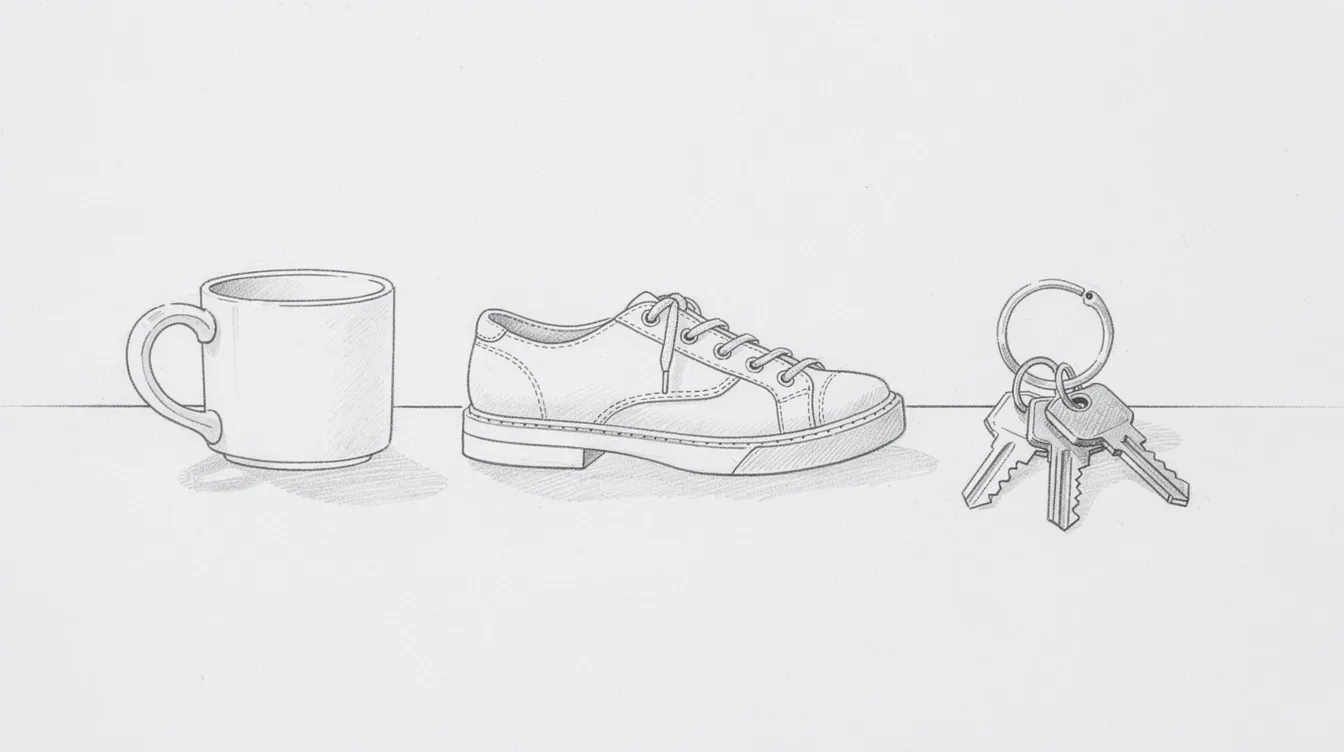
Days 11 to 20: Draw from life for 10 to 20 minutes a day. Keys, cutlery, shoes, a houseplant. Use a pencil and printer paper or a cheap sketchbook. Beginners often improve their observational skills through practice with real-life references, and the first months are crucial for developing basic drawing skills such as line control and shapes.
Days 21 to 30: Add simple shading to one object a day. Observe where the light comes from, where the shadow falls, and practice focused exercises on perspective and basic forms.
Starting with fundamentals speeds up learning far more than jumping straight into polished portraits or detailed fantasy scenes. I encourage you to pick a tiny daily commitment, 15 minutes after dinner, and treat it like brushing your teeth: non-negotiable but brief. If you want help turning that into a routine, I wrote a separate guide on building a daily drawing habit.
My lines were shaky and my drawings came out flat for weeks. Improved hand-eye coordination and the ability to draw basic forms mark early progress, and a clumsy first month is the plan working, not a sign of no talent. You will discover that quickly enough.
What skills are you actually learning in the first 1 to 2 years?
There are a handful of core skills that basically every adult learner builds in this period, regardless of whether they eventually want to do urban sketching, landscapes, comics, or abstract work. The fundamentals are the same.
Seeing like an artist is the first skill I noticed. Drawing from observation helps develop accuracy in shapes and proportions. One evening I stopped drawing “a cup” and started drawing the angles, spaces, and shadow in front of me. That movement in perception changed everything. 3D vision helps visualize objects as volumes, not flat outlines, and that shift is what people mean when they talk about “learning to see.”
Line control comes next. You go from scratchy, hesitant marks to steadier, more confident lines with varied weight.
Proportion is where you learn to compare widths and heights, to measure by eye. Getting the shape of a mug right relative to its handle is a small wow moment, but it sticks.
Value and light make things look solid. You stop relying on outlines and start using light and dark to create form.
Basic perspective lets you draw boxes, simple interiors, and objects turning in space without everything looking skewed.
Daily practice can lead to noticeable improvement in six months. Around that point, you might sketch the corner of your kitchen and realize it actually looks like your kitchen. The composition holds together. That is when confidence starts to build.
Example timelines: from complete beginner to confident hobby artist
Here are three realistic paths. None of them is the “right” one.
The slow and steady learner draws 10 to 15 minutes a day, four to five days a week. At three months, simple objects come out roughly right. At six months, basic shading and perspective appear. By two years, this person feels like a solid hobby artist. Daily drawing sessions of 20 minutes can yield quick progress, and daily practice of 20 minutes can yield significant improvement even at this gentle pace.
The focused evening hobbyist draws 30 to 45 minutes most days. At three months, lines and shapes are much more reliable. At six months, they can sketch a living room with simple shading that friends immediately recognize. At a year, materials and proportion feel natural.
The intensive learner puts in one to two hours a day. By nine to twelve months and roughly 200 hours, they handle representational sketches and start tackling harder subjects like figure drawing or portraits.
Focused practice improves sketching faster than random drawing, and focused exercises improve sketching faster than random drawing. That is not a typo. It is the single most important point in this post.
Now, the related questions people frequently ask. Can you improve drawing only on weekends? Yes, but progress will be slower. Can you get decent with 20 minutes most days? Absolutely. Will you lose progress if you skip a week? No. Your skills are stored. You might feel rusty for a session, but nothing is wasted.
Here is the hard part nobody explains in the first place. Around months four to eight, you hit what I call the awkward middle. Your eye improves faster than your hand, so you can see every flaw you cannot yet fix. Many people quit here, believing they have plateaued. But that gap between seeing and doing is the sign that the process is working. Eventually the hand catches up. If you are stuck in that stretch, my guide on ways to improve faster lays out what to try next.
How to practice smarter so you do not waste years
There is a huge difference between mindless repetition and targeted practice. If you spend five years drawing the same cartoon eye, you will be great at that one eye and stuck on everything else. Skipping fundamentals can lead to years of unproductive practice. Focused practice on fundamentals accelerates drawing progress.
A simple weekly structure I teach to beginners in my group: two sessions a week on pure fundamentals (lines, boxes, value scales, simple perspective), two sessions drawing from life (cups, shoes, plants, rooms), and one to two sessions drawing things you enjoy with the same skills, whether that is scenery, abstract shapes, or something from your imagination. For specific drills to fill those sessions, see my list of simple drills for beginners.
Distributed practice, the learning-research idea that short sessions spread through the week beat one marathon, applies to hand skills just as much as memorizing facts. Deliberate practice focusing on weaknesses accelerates drawing skills better than mindless doodling. Feedback from experienced artists can significantly accelerate learning and help correct mistakes, so even an occasional class or online critique helps. Tailoring practice routines to individual goals can enhance learning effectiveness.
Set specific goals per session. “Draw ten cylinders” beats “draw something.” Haha, it sounds boring, but it works. Learning proper techniques unlocks creativity in sketching because you stop fighting the pencil and start using it. Sketching should be a focused activity to ensure progress. Focused practice is more effective than random drawing.
And a tip: do not buy gear instead of practicing. A new set of pencils feels like progress but is not. The pencil you have right now and a piece of paper are enough to begin.

Learning to draw as a busy adult: mindset and expectations
The three fears I hear most often: “I am too old to start,” “I do not have talent,” and “If I cannot draw realistically in three months, it means I am bad at this.” All three are wrong. Whether it is too late to learn to draw as an adult is a question with a clear answer from brain science: the adult brain still changes. Practicing daily can help build muscle memory and visual processing speeds more effectively at any common age. Fifteen minutes a day is enough. If you want a longer look at whether it’s too late to learn to draw as an adult, I wrote about it separately.
What looks like talent in the art world is almost always early exposure and years of quiet practice before anyone saw the results. Most adults underestimate what a year of small, steady effort can do and overestimate what they should achieve in the first few weeks. Drawing is a long-term skill like a language or running. It keeps improving as long as you use it and does not expire at a certain pace tied to age.
I came to drawing at 44 after twenty years of bookkeeping. I fit it around a normal workday. The shift that made the biggest difference was changing my goal from “be perfect fast” to “show up this week.” Constant comparison with artists who have ten years on you is a fast way to quit. Instead, I encourage you to track progress with dated sketchbook pages and redraw the same subject, a corner of a room, for example, every three months. You cannot feel progress day to day, but flipping back through old images is undeniable.
Conclusion: what to expect in your next 12 months of drawing
In plain words: about three months to draw simple recognizable objects. Six to twelve months to feel more confident with lines, proportion, and basic shading. One to two years of consistent practice to feel like a solid hobby artist who can create sketches of most everyday scenes reasonably well.
A clumsy first step is normal. Do not wait for a perfect moment or a complete free weekend. Start this week. My challenge for you: 20 minutes a day for the next 30 days, drawing only objects you can reach from your chair.
That is what The Hobby Artist is about. Realistic routines, honest mindset, simple exercises. If you found this post helpful, drop a note in the comments or send me an email. Questions about where to begin are my favorite kind.
FAQ
Can you learn to draw in 30 days?
Real progress is possible in 30 days: steadier lines, simple objects, and basic shading. You will not be an accomplished artist, but a month of daily practice is a strong start and usually enough to know whether you want to continue. I would not call that time wasted under any direction of looking at it.
How many hours does it take to learn to draw?
There is no fixed number, but many adults reach comfortable, recognizable drawings after roughly 100 to 200 hours of focused practice. At 30 minutes a day, that is six months to a year. Some YouTube tutorials or a college course might promise faster results, but the honest answer is that the hours add up quietly and the point is to keep showing up.
Why do I feel like I’m getting worse at drawing?
Usually your eye has improved faster than your hand, so you notice more mistakes. Compare old pages to new ones to see the progress. This is the awkward middle I describe above, and it is a sign of growth, not failure.
Is it better to draw every day or a few times a week?
Daily is ideal, even for 15 minutes, but three or four sessions a week still works well. Consistency matters more than the exact schedule. Paint, draw, sketch, whatever word you use for it, just do it on a rhythm your life can sustain.